The Fastest Networks Often Operate Over the Shortest Distances
When people first encounter 800G optical networking, they often assume the technology is primarily about extending reach.
After all, higher-end optical systems frequently advertise transmission distances of several kilometers, dozens of kilometers, or even farther. It seems natural to associate more advanced optics with longer transmission capabilities.
Inside modern AI clusters, however, the opposite is often true.
Many of the most critical network links in the entire infrastructure are surprisingly short. They may connect servers in neighboring racks, link leaf switches to spine switches, or interconnect compute pods located only a few meters apart.
The challenge is not distance.
The challenge is moving enormous amounts of data across those short distances as efficiently as possible.
This is exactly the environment where 800GBASE-SR8 optical modules have become essential.
Why AI Traffic Looks Different from Traditional Data Center Traffic
Enterprise networks and AI fabrics may share some hardware components, but the traffic patterns are fundamentally different.
In a traditional enterprise environment, traffic often flows between users and applications. Communication tends to be intermittent, with workloads distributed across many different systems.
AI training environments operate in a much more synchronized manner.
Thousands of GPUs may participate in a single workload. During training, these accelerators continuously exchange gradients, parameters, and synchronization information. Communication occurs constantly and at extremely high volumes.
Because of this, network links are frequently pushed closer to their maximum capacity than in conventional data center deployments.
Every bottleneck matters.
Every delay becomes visible.
And every layer of unnecessary complexity can impact overall cluster performance.
Why Long Reach Doesn’t Always Equal Better Design
A common misconception in networking is that more reach automatically means a better optical solution.
In reality, the best optical module is usually the one designed for the actual deployment environment.
Most AI clusters are highly concentrated. Infrastructure teams intentionally place servers, storage systems, and switching equipment close together to reduce latency and simplify operations.
As a result, the majority of optical connections never need to travel beyond a few dozen meters.
Deploying long-range optics in these situations would provide little practical benefit while potentially increasing overall infrastructure costs.
The NVIDIA/Mellanox MMA4Z00-NS compatible 800GBASE-SR8 module is designed around this reality.
Operating at 850nm over multimode fiber and supporting distances up to 50 meters, it focuses entirely on the environment where most AI traffic actually exists.
The Importance of Bandwidth Density
One of the defining characteristics of modern AI infrastructure is density.
A single rack today may contain more computing power than an entire data center from a decade ago. GPU counts continue rising, and switch platforms now deliver aggregate bandwidth measured in tens of terabits per second.
As density increases, the network must scale alongside it.
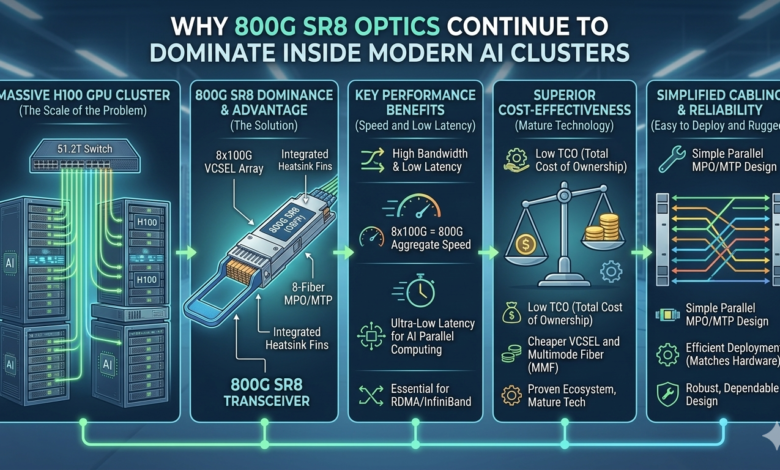
The 800G SR8 architecture helps address this challenge by providing extremely high bandwidth within a compact OSFP form factor.
Rather than requiring multiple lower-speed connections to achieve the desired throughput, a single 800G link can handle the workload directly.
This reduces cable count, simplifies network layouts, and improves port utilization throughout the infrastructure.
In large deployments, these efficiencies accumulate quickly.
Why the Twin-Port 2×SR4 Design Matters
At first glance, the 2×SR4 architecture may seem like a technical detail.
In practice, it provides valuable flexibility.
The MMA4Z00-NS compatible module effectively supports two independent 400G optical paths within a single OSFP transceiver. This allows network architects to choose between native 800G operation and various breakout configurations depending on deployment requirements.
Some clusters prioritize maximum bandwidth between switching layers.
Others benefit from distributing connectivity across multiple 400G channels.
The ability to support both approaches helps operators adapt infrastructure as workloads evolve without changing the optical platform itself.
That flexibility becomes increasingly useful in rapidly growing environments where future traffic patterns are difficult to predict.
Air Cooling Remains the Industry Standard
Although liquid cooling receives significant attention within the AI industry, most networking infrastructure today continues operating inside air-cooled environments.
This is particularly true for switching platforms.
NVIDIA Quantum-2 InfiniBand and Spectrum-4 Ethernet switches are frequently deployed in facilities that still rely heavily on traditional airflow-based cooling systems. As port speeds increase, maintaining thermal stability becomes more challenging.
The open-finned top design used in the MMA4Z00-NS compatible module addresses this requirement directly.
By maximizing airflow across the transceiver surface, the module helps dissipate heat more effectively and maintain stable operating conditions within high-density switch deployments.
Reliable thermal performance contributes directly to long-term network stability.
Why Reliability Often Matters More Than Peak Speed
When discussing 800G networking, bandwidth naturally receives most of the attention.
Yet operators managing large AI environments often prioritize something else: consistency.
An unstable optical link can affect thousands of GPUs simultaneously. A failed connection can interrupt distributed workloads that have been running for days. In these environments, predictable behavior is often more valuable than achieving theoretical maximum performance.
This is one reason Digital Diagnostic Monitoring (DDM) remains important.
Visibility into temperature, optical power levels, and transceiver health allows infrastructure teams to identify potential issues before they impact production workloads.
Reliable networks are built on reliable components.
The optical layer is no exception.
Supporting the Continued Growth of AI Infrastructure
The scale of AI clusters continues increasing at a remarkable pace.
What was considered a large deployment just a few years ago may now represent an entry-level training environment. New generations of accelerators require more bandwidth, larger fabrics, and increasingly efficient communication between nodes.
As a result, the importance of high-performance short-reach optics continues growing.
The role of modules such as the MMA4Z00-NS compatible 800GBASE-SR8 transceiver is not simply to provide connectivity. Their purpose is to support the dense, communication-intensive environments that modern AI infrastructure depends on.
As long as large-scale AI training remains concentrated inside data centers, short-reach 800G optics will continue playing a central role in network design.
Conclusion
The NVIDIA/Mellanox MMA4Z00-NS compatible 800GBASE-SR8 (2×SR4) OSFP optical transceiver reflects a fundamental trend in modern AI networking: the highest-performance links are often deployed over the shortest distances. By combining 800G bandwidth, multimode fiber connectivity, a flexible twin-port architecture, and optimized thermal performance for Quantum-2 InfiniBand and Spectrum-4 Ethernet switches, it addresses the needs of dense, high-bandwidth computing environments. Rather than focusing on reach, SR8 technology focuses on delivering efficient, reliable communication where AI workloads generate the most traffic—inside the data center itself.